
Solar Grounding Lugs & Grounding Clips
Grounding lugs, module bonding clips and related hardware for compatible PV mounting rails and framed modules. Match each part to the rail profile, module frame, conductor and approved grounding or bonding design before ordering.

Component choice depends on the complete mounting-system and electrical design.
Grounding lugs and bonding clips do different jobs
A lug normally provides a conductor termination point on a compatible rail or structure. A clip or bonding washer is normally used at an approved module-to-rail or clamp interface. They should not be treated as interchangeable parts.
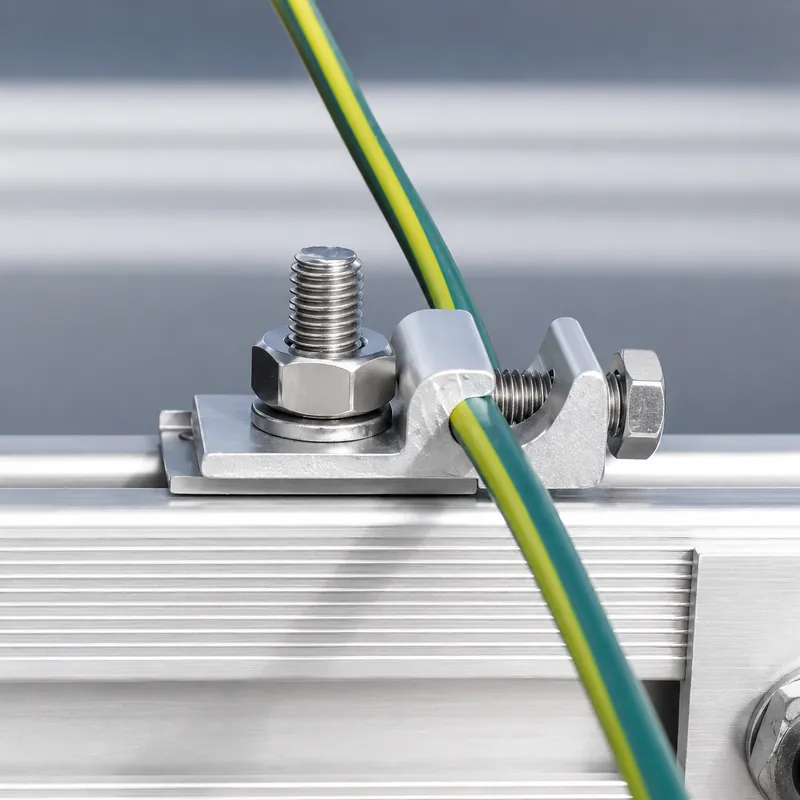
Grounding lugs
Used where a grounding or bonding conductor terminates at an approved rail or structural connection point. Confirm conductor range, rail interface, fastener and installation requirements for the selected system.

Bonding clips / grounding clips
Placed at a compatible module-frame and rail or clamp interface where the mounting system is designed to create the required electrical bond. Geometry and contact position must match the actual components.

Rail bonding hardware
Jumpers, connectors or other approved bonding parts may be required where rail sections, structural interfaces or expansion details interrupt the intended electrical path.
What to confirm before selecting each part
The useful selection data is the interface information, not a generic product name alone.
| Check | Grounding lug | Bonding / grounding clip |
|---|---|---|
| Main role | Terminates a compatible conductor at a rail or approved structure point | Creates an approved electrical contact at a module, clamp and rail interface |
| Key dimensions | Rail slot or mounting point, lug body, bolt and conductor channel | Module frame, rail top surface, clamp geometry, clip width and contact position |
| Electrical information | Conductor material and size range; required bonding path | Approved bonding path through the module and racking system |
| Installation information | Fastener type, torque and orientation from the applicable product/system documentation | Clamp position, orientation and tightening requirements from the applicable product/system documentation |
Match the complete electrical and mechanical interface
Grounding and bonding hardware should be selected from the approved mounting-system design and project electrical requirements. Similar-looking parts can have different contact geometry, conductor ranges or fastening methods.
Module-to-rail contact
Check the framed module, clamp location, rail profile and the exact clip or bonding element intended for that interface. Do not assume a clip fits every module clamp or every rail family.
- Module frame profile
- Approved clamp zone
- Rail top / channel geometry
- Clip orientation and contact points
Rail-to-conductor connection
Check both sides of the connection: how the lug attaches to the rail and how the conductor is retained. Conductor size alone is not enough to establish compatibility.
- Conductor material and size
- Lug channel / clamping method
- Rail slot or mounting point
- Fastener and torque requirement
Available grounding and bonding component types
Easy Solar can discuss standard parts and drawing-based variants after the interface and project requirements are confirmed.
Rail grounding lugs
Lug assemblies for compatible rail-to-conductor terminations, supplied with matched mounting hardware where specified.
Module bonding clips
Clip or washer styles for compatible framed-module, clamp and rail interfaces.
Rail bonding parts
Project-specific bonding jumpers, connectors or contact parts for rail sections and structural interfaces.
Drawing-based hardware
Custom lug bodies, clips, plates, holes, slots, fastener sets, finishes, labels and packaging subject to technical review.
Technical information to send with your inquiry
For accurate matching, provide the actual component interfaces instead of relying on a generic description such as “solar grounding clip.”
| Connection point | Module-to-rail, rail-to-rail, rail-to-structure or rail-to-conductor |
|---|---|
| Module / clamp | Module frame drawing or profile, clamp model and approved clamping position |
| Rail | Cross-section, slot dimensions, surface/finish and relevant mounting point |
| Conductor | Material, size, routing and termination requirement |
| Fasteners | Bolt, nut, washer, thread and any specified tightening requirement |
| Project documents | Drawing, bill of materials, applicable mounting-system instructions and quantity |
| Supply details | Material/finish requirement, labels, packaging and delivery plan |
Check the parts that connect to the grounding hardware
Need a matched lug, clip or bonding part?
Send the relevant drawings and interface details. Easy Solar can review standard component options or discuss drawing-based manufacturing for professional project and OEM requirements.
Send Technical Details →Useful files to include
- Rail cross-section or sample drawing
- Module frame and clamp information
- Conductor material and size
- Connection detail or grounding/bonding layout
- Required quantity and packaging
Grounding lug and bonding clip questions
What is the difference between a grounding lug and a grounding clip?
A lug generally provides a conductor termination at a compatible rail or structure point. A clip or bonding washer generally creates electrical contact at an approved module, clamp and rail interface. The exact function depends on the mounting-system documentation.
Can one grounding clip be used with any module clamp?
No. Compatibility depends on the module frame, clamp design, rail profile, clip geometry and approved installation position.
Can one grounding lug fit different conductor sizes?
Only if the selected lug is specified for those conductor materials and sizes. Confirm the conductor range and installation method for the actual part.
Does a rail splice automatically bond two rail sections?
Not necessarily. Mechanical connection and electrical bonding are separate design questions. Follow the selected racking-system documentation and the project grounding/bonding design.
What should I provide for a quotation?
Send the connection point, rail profile, module/clamp details, conductor information, fastener requirements, drawing or sample, quantity and packaging requirements.