
Ballasted vs Mechanically Attached Solar Mounting for Flat Roofs
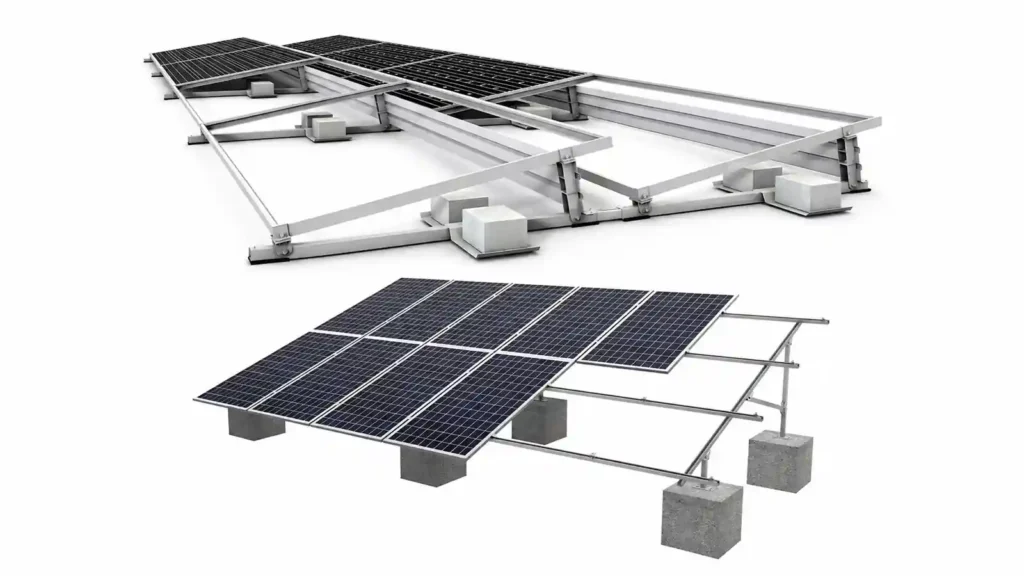
Choosing a flat roof solar mount usually comes down to three structural approaches: ballasted, mechanically attached, or hybrid.
A ballasted system uses weight to help resist movement and wind uplift while reducing or avoiding roof penetrations in suitable designs. A mechanically attached system connects the PV racking directly to the building structure through engineered attachment points. A hybrid system combines both methods when a project needs to reduce ballast weight, increase resistance in critical roof zones, or balance structural and waterproofing requirements.
None of these options is automatically better.
The right choice depends on roof load capacity, membrane condition, building height, wind exposure, snow load, drainage, roof warranty requirements, array layout, maintenance access, and the building structure below the roof.
If you need the broader rooftop context first, see Solar Panel Roof Mounting Systems and Flat Roof Solar Mounting System.
Ballasted vs Attached Flat Roof Solar Mounting at a Glance
| Factor | Ballasted Mounting | Mechanically Attached Mounting | Hybrid Mounting |
|---|---|---|---|
| Primary Restraint | Ballast weight + racking geometry | Mechanical connection to building structure | Ballast + selected mechanical attachments |
| New Roof Penetrations | Often reduced or avoided | Required at attachment points | Limited / project-specific |
| Added Roof Weight | Higher | Lower | Medium / optimized |
| Waterproofing Detail | Focus on membrane protection and load distribution | Critical at every penetration | Both membrane protection and sealed attachments |
| High-Wind Flexibility | Can become ballast-intensive | Often more practical where strong anchorage is required | Useful where full ballast is not preferred |
| Installation Logistics | Requires moving and placing ballast | Requires attachment layout and waterproofing work | More coordination |
| Roof Access / Maintenance | Depends on racking footprint and ballast layout | Depends on attachment and row layout | Project-specific |
| Best Fit | Roofs with adequate reserve capacity where penetrations should be minimized | Roofs where dead-load limits or wind conditions favor structural attachment | Projects that need a balance of weight, penetration, and wind performance |
This comparison should be used as a project-planning framework rather than a universal specification.
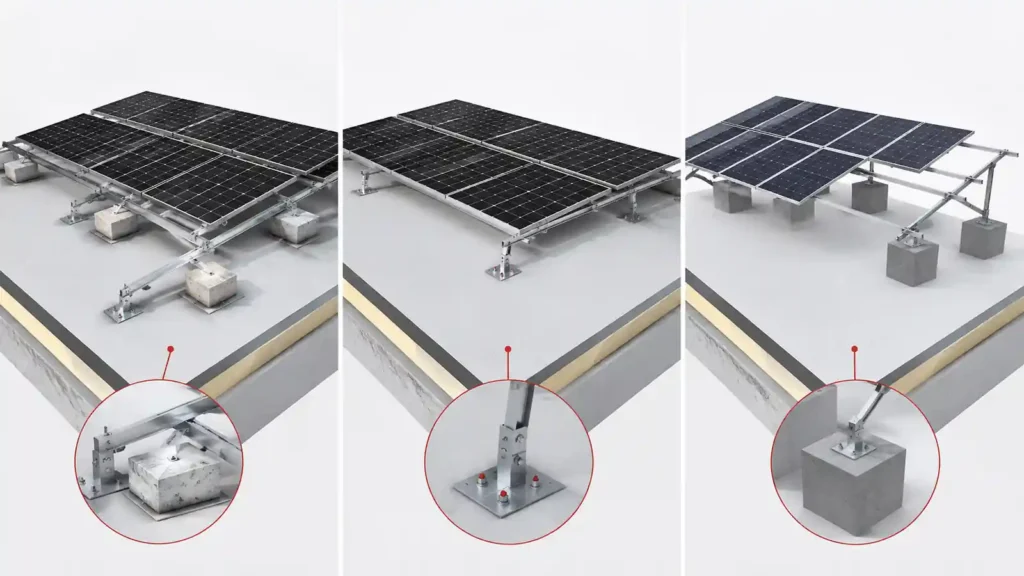
What Is Ballasted Flat Roof Solar Mounting?
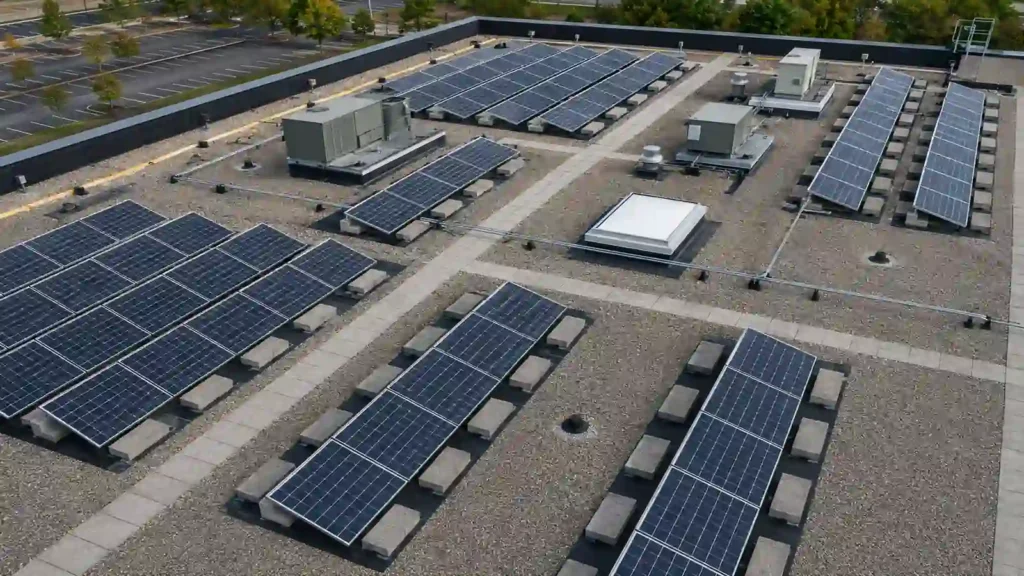
A ballasted flat roof solar mounting system uses concrete blocks, weighted trays, or other engineered ballast as part of the system that keeps the PV array in position.
The racking normally rests above the roof membrane on protection pads or compatible contact surfaces. The modules are held at a fixed low tilt using aluminum rails, triangle rack, module clamps, fasteners, and in some systems wind deflectors.
The attraction is straightforward: the system can reduce or avoid mechanical penetrations through selected roof membranes.
That can be valuable on commercial and industrial roofs where roof waterproofing, membrane warranty, installation speed, or future removability are important.
However, the word “ballasted” does not mean that the design is simply a matter of adding concrete blocks until the array feels heavy enough.
The required ballast depends on the complete project, including:
- Building height
- Roof geometry
- Parapets
- Array position
- Module dimensions
- Tilt angle
- Row spacing
- Wind conditions
- Roof surface
- Friction assumptions
- Structural load capacity
- Applicable design requirements
A flat roof ballasted solar racking system therefore still requires structural and layout review.
This article focuses on when ballasted mounting is preferable to attached mounting. A future dedicated guide can go deeper into ballast trays, wind deflectors, friction, ballast calculation inputs, and detailed ballasted-system mechanics.
What Is Mechanically Attached Flat Roof Solar Mounting?
A mechanically attached system connects the PV mounting structure to the building through engineered roof attachment points.
The connection may pass through the roof membrane and insulation to a structural deck, joist, beam, concrete slab, or another approved structural element, depending on the building.
The main advantage is that the array does not need to rely primarily on large amounts of ballast weight.
This can be important when:
- Roof reserve load capacity is limited
- Building height or wind exposure increases uplift demand
- The ballast quantity required by a fully ballasted concept becomes impractical
- The project needs a more direct structural load path
- Roof zones require additional anchorage
- The desired array geometry cannot be achieved efficiently with ballast alone
The tradeoff is that every penetration becomes both a structural connection and a waterproofing detail.
The mounting attachment, fastener, flashing, membrane interface, seal, and installation procedure need to work together.
A mechanically attached system should therefore not be described simply as a “lighter ballasted system.” It is a different load-transfer strategy.
What Is a Hybrid Flat Roof Solar Mounting System?
A hybrid system combines ballast and mechanical attachments.
For example, the center of an array may use ballast while selected roof zones or structural lines use mechanical attachments.
A hybrid approach can be useful when the project needs to:
- Reduce total ballast weight
- Limit the number of roof penetrations
- Improve resistance in higher-load roof zones
- Work around structural or roof-load limitations
- Adapt to different conditions across a large roof
- Coordinate with parapets, equipment, drains, and access routes
Hybrid mounting should not be treated as a compromise selected simply because the project team cannot choose between the other two methods.
It should have a clear structural reason.
The design should define where ballast is used, where attachments are used, how loads are distributed, and how the roof remains inspectable and maintainable.
1. Roof Penetrations and Waterproofing
Roof penetration is often the first issue buyers compare.
Ballasted Systems
A properly designed ballasted system can reduce or avoid new penetrations on suitable flat roofs.
That can simplify the interface with single-ply membranes such as TPO, PVC, or EPDM because the racking does not necessarily need to be mechanically connected through the membrane at every support location.
However, avoiding penetrations does not eliminate roof-protection requirements.
The system still needs to protect the membrane against:
- Concentrated loads
- Abrasion
- Sharp edges
- Movement
- Trapped debris
- Standing water
- Incompatible contact materials
Roof pads, compatible contact surfaces, drainage clearance, and load distribution remain important.
Mechanically Attached Systems
Attached systems intentionally create structural connection points through the roof assembly.
These points require proper water management.
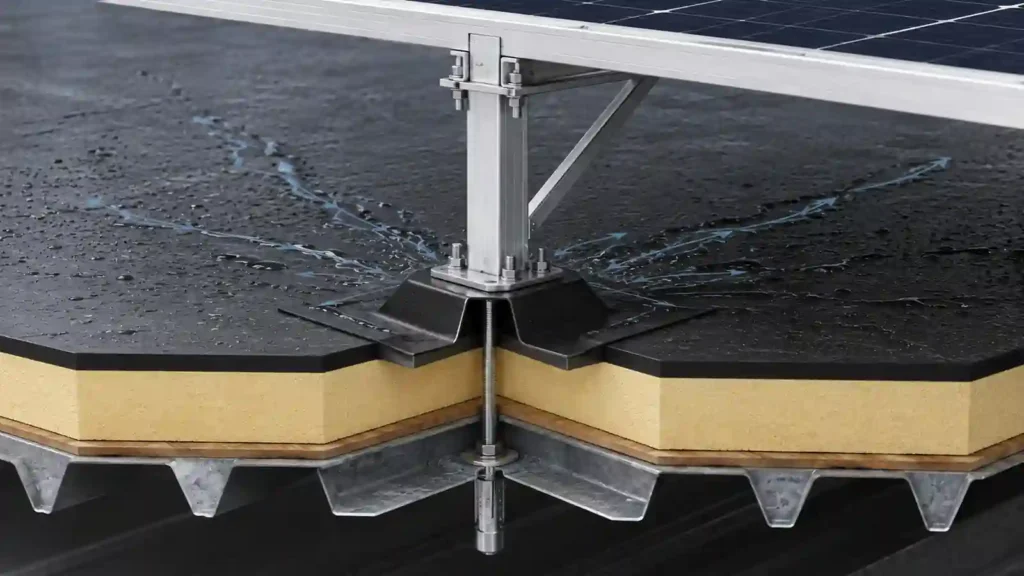
The penetration detail may involve flashing, curbs, boots, compatible seal components, or roof-system-specific attachment assemblies.
The correct solution depends on the membrane and roof construction.
The important principle is that waterproofing should be part of the mounting design from the beginning rather than added after the attachment layout is finalized. PNNL likewise treats flashing and integration with the roof water-control layer as part of proper solar roof attachment design.
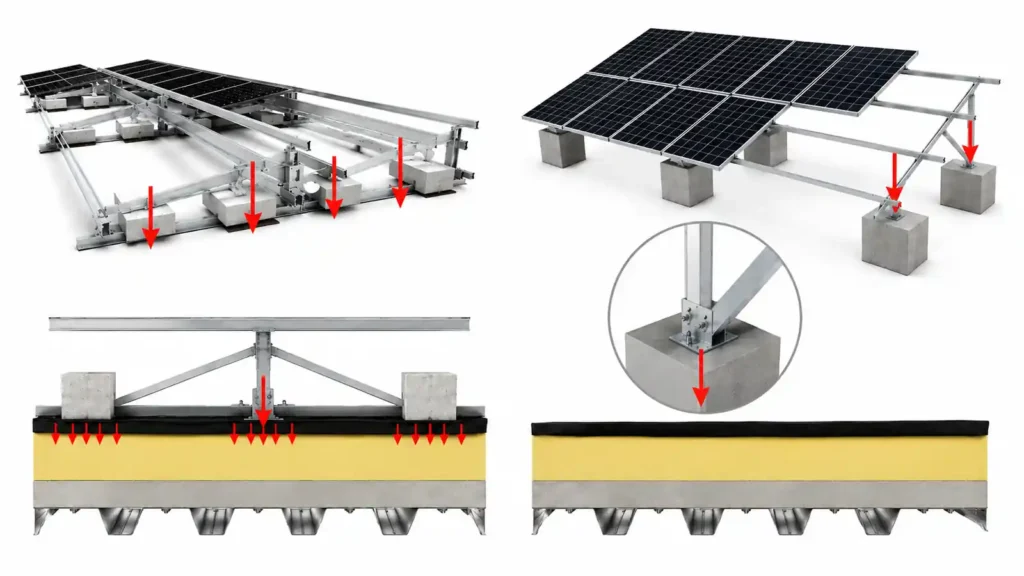
2. Roof Structural Capacity and Added Dead Load
Ballast adds dead load to the roof.
The amount is not universal. It varies with system aerodynamics, roof height, wind conditions, tilt, layout, attachment strategy, and the location of each racking zone.
For a large commercial rooftop, the total quantity of ballast can become a major structural and logistical consideration.
A roof with adequate reserve capacity may support the required ballast efficiently.
A roof with limited reserve capacity may require:
- Reduced ballast
- Mechanical attachment
- Hybrid mounting
- A different array layout
- Lower tilt
- Different row spacing
- Structural reinforcement
- A smaller PV array
Mechanically attached mounting usually reduces the need for heavy ballast because wind and other reactions are transferred through structural attachments.
However, attachment reactions still need to be checked against the building structure.
The comparison is therefore not “heavy versus light” alone.
It is distributed roof load versus concentrated structural attachment reactions.
Both need engineering review.
3. Wind Uplift and Building Height
Wind is one of the most important factors in the ballasted-versus-attached decision.
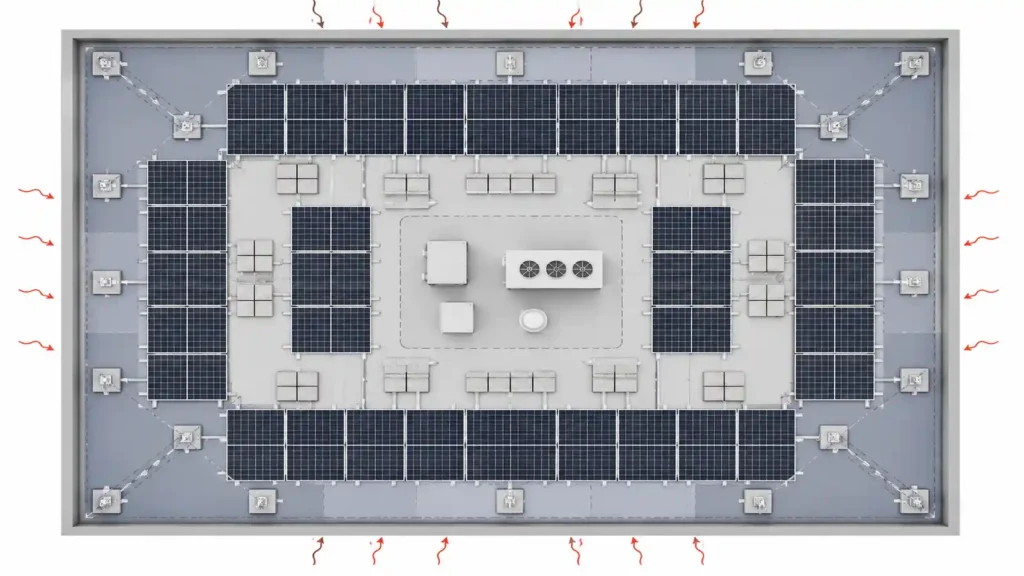
Wind flow over roof edges, corners, parapets, penthouses, and other obstructions can create different pressure zones across the roof.
A ballasted system resists these forces using a combination of system geometry, interconnected racking, ballast weight, friction, aerodynamic features, and the roof interface.
As wind demand increases, the required ballast can also increase.
At some point, additional ballast may become structurally or logistically inefficient.
Mechanically attached systems transfer uplift through defined structural connections and can therefore be useful where stronger anchorage is required.
Hybrid systems can also be used to add mechanical restraint at strategic locations while limiting overall penetration count.
DOE’s current severe-weather guidance specifically recommends strategic mechanical attachments rather than relying on fully ballasted rooftop PV systems in high-wind situations.
Building height matters because a low warehouse and a tall commercial building should not automatically use the same ballast assumptions.
The final system should follow the project wind design rather than a generic statement such as “ballasted systems are suitable up to a certain wind speed.”
4. Roof Membrane and Protection
Flat roofs can use different roof coverings, including TPO, PVC, EPDM, modified bitumen, built-up roofing, and other membrane or coating systems. PNNL’s low-slope roof guidance likewise distinguishes several membrane roof types and emphasizes wind-uplift resistance for low-slope roofs.
Mounting selection should consider:
- Membrane material
- Membrane age
- Roof warranty
- Surface friction
- Compatibility with protection pads
- Existing repairs
- Drainage
- Ponding areas
- Roof slope
- Roof replacement schedule
For ballasted systems, the contact between the racking and the roof is especially important because the array can cover a large membrane area.
The protection pad should be compatible with the roofing material and should not create an abrasive or chemically incompatible interface.
For mechanically attached systems, the membrane detail is concentrated around the attachment points, but those penetrations become critical waterproofing locations.
If the roof is near the end of its service life, replacing or repairing the roof before installing a long-life PV array may be more practical than designing around a membrane that will soon need major work.
5. Installation Logistics
Ballasted mounting is often described as faster because it can reduce drilling and flashing work.
That can be true, but ballast creates its own logistics.
The project may need to move large quantities of concrete blocks or other ballast to the roof, distribute them to the correct locations, and verify that temporary construction loads do not create a problem during installation.
Important questions include:
- How will ballast reach the roof?
- Is a crane or material lift required?
- Can ballast be staged safely?
- How will loads be distributed during construction?
- Can the roof membrane be protected during material handling?
- Is there sufficient access around equipment and roof edges?
Mechanically attached systems reduce ballast handling but increase the work required for attachment layout, drilling, structural fastening, and waterproofing.
The faster system depends on the actual building and installation plan.
6. Array Layout, Tilt, and Roof Utilization
Flat roofs provide more freedom to choose PV orientation and tilt than most pitched roofs.
Common layouts include:
- South-facing tilted rows
- East-west low-tilt rows
- Portrait module layouts
- Landscape module layouts
The mounting method can affect how much of the roof is usable.
Ballast trays, wind deflectors, support frames, and row spacing all occupy roof area.
Mechanically attached systems may allow a different structural spacing strategy.
East-west systems can improve roof-area utilization in suitable projects because rows can often be placed closer together than higher-tilt south-facing arrays.
However, array density should not be maximized at the expense of:
- Drainage
- Fire or service access
- Roof maintenance
- Equipment clearance
- Shading performance
- Ballast or attachment requirements
The best layout is the one that balances installed capacity with the long-term use of the roof.
7. Drainage and Maintenance Access
A flat roof continues to function as a roof after the PV system is installed.
Drains still need to work.
HVAC equipment, roof hatches, vents, skylights, membranes, and other rooftop systems still need inspection and maintenance.
A flat roof solar mount should therefore leave appropriate access for:
- Roof drains
- Scuppers
- Equipment
- Walkways
- Roof hatches
- Inspection areas
- Membrane repair
- Module replacement
Ballasted systems can create more contact points and ballast locations across the roof, so maintenance routes need to be planned carefully.
Attached systems may reduce ballast footprint, but attachment points and support frames still affect access.
Hybrid systems also require clear documentation so future maintenance teams understand which parts are structurally attached and which rely on ballast.
8. Future Roof Repair and Replacement
PV modules can remain in service for decades, while roof membranes may need repair or replacement during the life of the solar system.
This makes future roof work part of the mounting decision.
Questions to consider include:
- Can modules be removed without dismantling large sections of the racking?
- Can ballast be moved and restored accurately?
- Will attached penetrations need to be repaired if the system is temporarily removed?
- Can maintenance crews reach the membrane below or around the array?
- Is the roof likely to be replaced before the expected end of PV service life?
A mounting system that is easy to install but difficult to coordinate with future roofing work can increase lifecycle cost.
Ballasted vs Attached: Which Is Better?
Neither system is universally better.
Choose Ballasted Mounting When:
A ballasted system may be a strong option when:
- The roof has adequate reserve structural capacity
- Reducing roof penetrations is important
- The roof membrane is compatible with the support and protection system
- Wind conditions and building geometry allow a practical ballast design
- The project can manage ballast delivery and rooftop staging
- The layout provides acceptable drainage and maintenance access
Choose Mechanically Attached Mounting When:
Mechanical attachment may be more suitable when:
- Roof dead-load capacity is limited
- Wind uplift makes full ballast impractical
- A direct structural load path is preferred
- The roof structure provides suitable attachment locations
- The project can implement an approved waterproofing detail
- The attachment strategy improves layout or access
Choose Hybrid Mounting When:
Hybrid mounting may be appropriate when:
- Full ballast creates too much roof load
- Full mechanical attachment would create more penetrations than desired
- High-load roof zones need extra restraint
- Structural capacity varies across the roof
- The project benefits from combining ballast with selected structural anchors
The final decision should come from the roof and project conditions, not from a default product preference.
What Components Are Used in Flat Roof Solar Mounting?
The exact bill of materials changes with the mounting approach.
A flat roof solar mounting system may include:
- Base rails or structural supports
- Rails
- Tilt legs or triangular supports
- Mid clamps
- End clamps
- Rail clamps
- Ballast trays
- Ballast blocks
- Wind deflectors
- Roof protection pads
- Mechanical roof attachments
- Flashing or sealing components
- Stainless-steel fasteners
- Grounding and bonding hardware
- Cable-management parts
For rail and clamp selection, see Solar Panel Mounting Rails and Solar Panel Clamps.
The important point for procurement is that the BOM should follow the final mounting strategy.
A ballasted BOM, attached BOM, and hybrid BOM should not be treated as interchangeable lists with only the ballast blocks added or removed.
What Information Does a Supplier Need for a Flat Roof Project?
For a project-specific mounting proposal, provide as much of the following information as possible:
| Project Input | Why It Matters |
|---|---|
| Project location | Supports wind, snow, corrosion, and environmental review |
| Roof dimensions | Defines available array area |
| Roof drawings | Helps identify structure, equipment, drains, and access routes |
| Roof membrane type | Affects protection and waterproofing details |
| Roof age / condition | Supports lifecycle planning |
| Roof load information | Critical for ballast feasibility |
| Building height | Influences wind exposure |
| Parapet height | Can affect rooftop wind behavior |
| PV module datasheet | Confirms dimensions, weight, and mounting zones |
| Module quantity and layout | Determines racking quantities and row geometry |
| Preferred tilt / orientation | Affects row spacing, wind, and structural configuration |
| Wind requirements | Influences ballast or attachment design |
| Snow requirements | Adds structural load |
| Penetration restrictions | Influences ballasted, attached, or hybrid selection |
| Roof warranty requirements | May affect attachment and membrane procedures |
| Delivery / order scope | Supports BOM, packing, and quotation planning |
Providing complete project information allows the mounting supplier to compare structural approaches instead of simply quoting a generic flat roof solar mount.
Common Mistakes When Choosing Flat Roof Solar Mounting
Assuming Ballasted Means “No Engineering”
Ballast is part of a structural design.
The amount and location of ballast depend on wind, roof geometry, layout, structural capacity, and the selected racking system.
Assuming Attached Means “Leak Risk”
A mechanical attachment is not automatically a leak.
The issue is whether the attachment and waterproofing detail are appropriate for the roof system and installed correctly.
Selecting Full Ballast Before Checking Roof Capacity
A non-penetrating concept can still be unsuitable if the roof cannot support the required ballast.
Ignoring Wind Zones Across the Roof
Edge and corner areas can have different wind conditions from central roof areas.
The mounting strategy may need to change by zone.
Blocking Drains or Maintenance Routes
Roof-area utilization should not override drainage and access requirements.
Ignoring Roof Replacement Timing
A new PV array should not make an already-aging roof unnecessarily expensive to replace.
Comparing Only Hardware Price
The mounting decision also affects engineering, ballast handling, waterproofing, installation labor, maintenance, future roof work, and total lifecycle cost.
Common Questions About Ballasted and Attached Flat Roof Solar Mounting
What is the difference between ballasted and attached solar mounting?
Ballasted mounting uses weight as part of the system that resists movement and uplift, while attached mounting transfers loads through mechanical connections into the building structure.
Is ballasted solar mounting non-penetrating?
Many ballasted flat roof systems are designed to reduce or avoid roof penetrations, but not every project can remain fully ballasted. High wind, roof-load limits, or other structural conditions may lead to a hybrid or mechanically attached design.
Is a ballasted solar system too heavy for a flat roof?
It can be if the roof does not have sufficient reserve capacity.
The required ballast varies by project, so roof structural capacity should be reviewed before the system is finalized.
Is mechanically attached solar better in high-wind areas?
Mechanical attachment can be preferable where a fully ballasted system would require impractical weight or where project engineering requires stronger structural anchorage. DOE specifically advises mechanical attachment rather than full ballast for rooftop PV in high-wind conditions.
The final configuration still depends on building geometry, wind design, roof structure, and the selected system.
Does mechanically attached solar damage the roof membrane?
It should not when the attachment is designed for the roof system and the penetration is properly flashed or sealed.
The waterproofing detail should be coordinated with the roof membrane and warranty requirements.
What is hybrid flat roof solar mounting?
Hybrid mounting combines ballast with selected mechanical attachments.
It can reduce total ballast while limiting the number of roof penetrations.
Which flat roof solar mount is cheapest?
There is no universal lowest-cost option.
Ballasted systems may reduce penetration labor but add ballast material and logistics. Attached systems reduce ballast but add structural attachment and waterproofing work. The most economical solution depends on the complete project.
Can ballasted solar racking be used on TPO, PVC, or EPDM roofs?
Potentially, yes, when the roof structure, membrane compatibility, load distribution, wind requirements, and protection-pad system are suitable.
The roof manufacturer and project design requirements should be reviewed before installation.
What information is needed for a flat roof solar mounting quotation?
Provide roof dimensions and drawings, membrane type, building height, roof-load information, module datasheet, array layout, preferred tilt, wind and snow requirements, penetration restrictions, and project location.
Select the Right Flat Roof Solar Mounting Strategy
Ballasted, mechanically attached, and hybrid systems solve the same basic problem in different ways.
A ballasted system can reduce roof penetrations but adds dead load.
A mechanically attached system creates a direct structural connection but requires engineered waterproofing at the attachment points.
A hybrid system can balance both approaches where roof load, wind, or roof-zone conditions make one method alone less practical.
The correct selection starts with the building—not with the racking catalog.
Review roof structure, membrane condition, wind and snow requirements, building height, drainage, maintenance access, module layout, and roof-lifecycle constraints before finalizing the system.
Explore Flat Roof Solar Mounting System for flat and low-slope rooftop options.
For a project-specific comparison, send your project details including roof drawings, module data, wind and snow requirements, membrane information, and available structural data.
References & Technical Sources
- U.S. Department of Energy — Severe Weather Resilience in Solar Photovoltaic System Design
https://www.energy.gov/cmei/femp/severe-weather-resilience-solar-photovoltaic-system-design - U.S. Department of Energy — Life Cycle of Photovoltaic Systems: Install and Commission a Photovoltaic System
https://www.energy.gov/cmei/femp/life-cycle-photovoltaic-systems-install-and-commission-photovoltaic-system - Pacific Northwest National Laboratory / Building America Solution Center — Roof Anchor System for Solar Panels
https://basc.pnnl.gov/resource-guides/roof-anchor-system-solar-panels - Pacific Northwest National Laboratory / Building America Solution Center — Low-Slope (“Flat”) Roofs
https://basc.pnnl.gov/resource-guides/low-slope-flat-roofs - U.S. Department of Energy Better Buildings — Becton Dickinson: Torrey View Solar Project
https://betterbuildingssolutioncenter.energy.gov/showcase-projects/becton-dickinson-torrey-view-solar-project

Sales Manager at Easy Solar Solar Mounting Systems. With over 1o years of experience in the solar industry, I specialize in providing reliable andcost-effective mounting solutions for distributors, installers, and EPC companies. Experienced in intemational sales and commited to building long-term partnerships worldwide.